
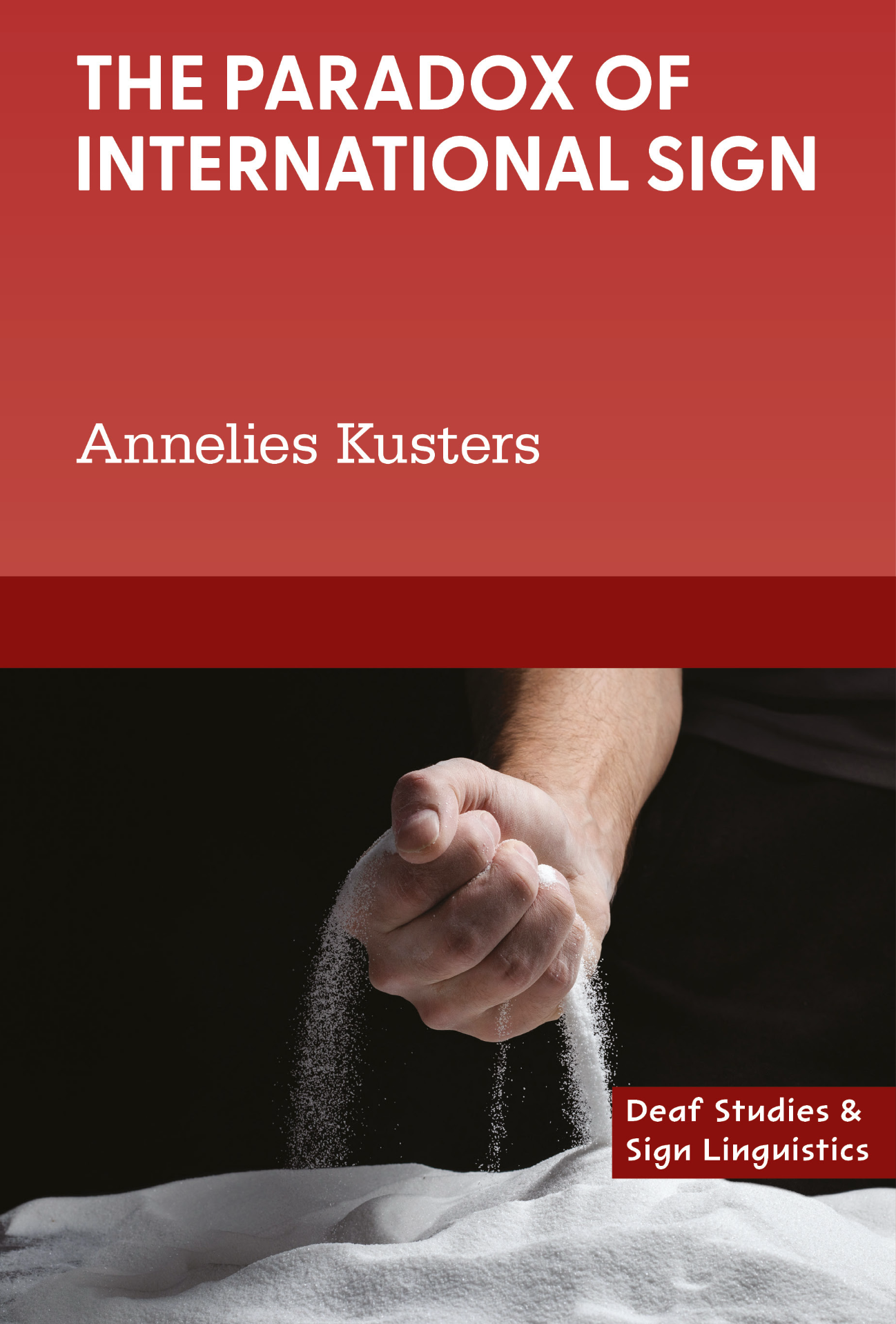
One of the writing-adjacent strings to my bow is developmental editing, and working with Professor Annelies Kusters on her most recent book, The Paradox of International Sign, was the most interesting editing job I’ve ever had. I strongly recommend having a look at it if you’re even remotely curious about sign languages, sociolinguistics and communication across language barriers.
And you should be curious! I know I’m biased (I’ve been using British Sign Language for seventeen years and did my PhD on signed storytelling traditions in Scotland in 2016 - read it here), but seriously, the nuances of sign languages and deaf communities and cultures are beyond fascinating. I’ll try to explain some of what this book as about here - hopefully without getting too geeky!
Since I first began learning BSL, one of the main questions I’ve been asked is: “why isn’t there one universal sign language?” The answer: for the same reason that there isn’t one universal spoken language. Language is rooted in the communities that use it, and there are have been deaf communities throughout the world for centuries. So there are not only different national sign languages, but different dialects within them. Many Edinburgh signs, for example, are different from Glasgow signs - and Glasgow itself has at least two dialects of BSL, one traditionally associated with Protestants and the other with Catholics.
Furthermore, even though both the UK and the USA use English, their national sign languages are completely different. The vocabulary of British Sign Language and American Sign Language is not mutually intelligible: because of how it developed, American Sign Language has much more in common with French Sign Language and Irish Sign Language!
The follow-up question is often: “well, why don’t they make an international sign language?” The short answer: well, how would you do it? How would you choose which sign language to base it on, and how would you get everyone to agree to use it? But the longer answer is: well, there kind of already is…
The problem is, when people use the terms International Sign Language or International Sign, they don’t always mean the same thing.
On the one hand, International Sign is the lingua franca used at conferences and at the EU and UN. This uses pre-established vocabulary which is ostensibly more visually motivated and therefore easier to understand than some of the more abstract signs used in national sign languages, but you do still need to know the signs and the conventions to understand it. This International Sign is seen as quite formal and high status, and ironically is not always particularly well understood.
And then there’s what happens when two or more deaf people who don’t share a sign language start chatting.
You know how I said that there are not only different sign languages, but different dialects of sign languages, and that these are not always mutually intelligible? That’s true. But also, although the vocabulary of, for example, British Sign Language and American Sign Language are very different, the basic visual-spatial grammar is the same, and all sign languages use similar descriptive techniques. A huge part of signing is creating images in the air, which you then manipulate, refer back to, and build on as the conversation progresses. So there’s a lot more overlap between the basic structure of two sign languages from different sign language families than there is between two spoken languages from different spoken language families.
Furthermore, because deaf communities are scattered and because sign languages have so many different dialects, deaf signers tend to be very comfortable with adapting to unfamiliar signs - they’re just used to it! So if two deaf people with no sign language in common meet, chances are they will be chatting away in a mash-up their respective languages in no time at all. They’ll each reduce the complexity of their sentences until they find common ground, and then build it back up again, creating or agreeing on vocabulary as they go, and changing how they sign depending on whether the other person seems to understand them. This is sometimes called translanguaging - the process of drawing on whatever language and communication tools we have to make to ourselves understood.
So the term ‘International Sign’ can mean the fixed, codified signing you might see on a conference stage, and the fluid, dynamic, responsive, in-the-moment interaction between signers, and anything at any point on the continuum between these two poles.
What Annelies has done in this book is unpick all the paradoxes embedded in the idea of ‘International Sign’ as a thing and as a process - and, in what I think is a genius move, she explores what International Sign is (or can be) in terms of the metaphors that deaf signers use to describe it. Using visual metaphors to explain complex ideas makes it so much easier to follow - and so much less dry and stuffy than a lot of other academic writing!
I’m a bit in awe of Annelies, to be honest. She is the first deaf scholar to achieve full professor status at a UK university, in this case Professor of Sociolinguistics at Heriot-Watt University in Edinburgh, and something I love about her work is that she’s massively committed to making her research accessible. The book is open access, so it’s free to download, and she created a playlist of signed videos summarising each chapter so that deaf people from non-academic backgrounds can still take part in the conversation.
I’ve worked with her before on Deaf Mobility Studies: Exploring International Networks, Tourism, and Migration (2024) - which is another excellent book that you should definitely look at. Deaf Mobility Studies had multiple authors and far more words than the word count would allow, so my input was mostly compressing arguments and shortening sentences (an irony for me, the queen of long sentences). For The Paradox of International Sign, however, I got to do my very favourite things as an editor: be pedantic, pick holes in arguments, ask facetious questions, and make suggestions to maximise head-explosion, mic-drop moments. And it was a joy!
Luckily, Annelies thought so too. She sent me flowers on the day the final manuscript was submitted to the publisher, and wrote this in the acknowledgements:

Right, that’s enough geekery and gushing for one day. If you made it all the way through, then definitely check out the book - and prepare for your mind to be blown!